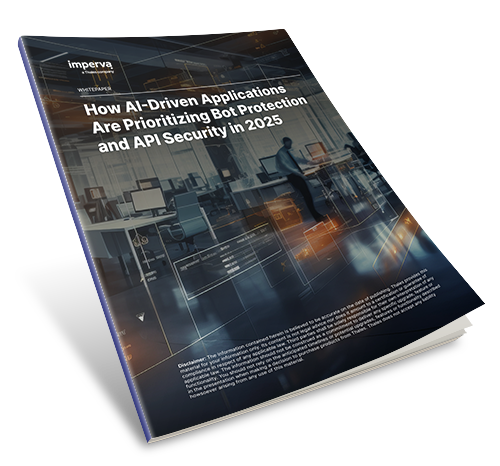


How AI-Driven Applications Are Prioritizing Bot Protection and API Security in 2025
Get Your Infographic

3600% AI legislation surges
Global lawmakers are increasingly focused on AI. Stanford University’s AI Index analysis of 127 countries found that...the number of bills containing “artificial intelligence” passed into law grew from just 1 in 2016 to 37 in 2022. Meanwhile, the EU fully rolled out its EU AI Act, positioning it as the first comprehensive legal framework for AI.

37% of all Internet traffic in 2024 come from Bad bots
Automated Internet traffic has overtaken human traffic for the first time in a decade. To make matters worse, bad bot traffic has risen...for the sixth consecutive year, now making up a whopping 37% of all Internet traffic. The digital landscape has never been more dangerous.
$6000 Oasis tickets?
Blame the bots
In one of the most notorious bad bot incidents of 2024, scalpers used AI tools to ...bypass security measures, purchase vast quantities of Oasis reunion tour tickets, and resell them at grossly inflated prices. Some resellers were believed to be listing tickets for as much as $6000 before sales officially opened.

33% of all attacks are OWASP automated threats
In 2024, one-third of all the attacks Imperva recorded and mitigated were OWASP-defined automated threats. The OWASP 21 Automated Threats are a set of ...automated cyberattacks that leverage bots and scripts to exploit web application vulnerabilities at scale, bypass security controls, and disrupt businesses across various industries. They are extremely easy to exploit and represent some of the most common and critical vulnerabilities facing web applications.
Top 5
AI security threats to APIs
With the rising reliance on AI-driven applications, here’s a look at some of the most pressing threats expected to challenge organizations in 2025:

Advanced Bot Attacks
Bots mimic human behavior to manipulate AI, enabling data scraping, fraud, and decision manipulation.

API Abuse
Attackers exploit insecure AI APIs to bypass security, steal data, and disrupt services, especially with sensitive LLM data.

Privacy Violations & Data Exposure
Weak AI/API privacy controls risk exposing sensitive user data and violating laws like GDPR.

LLM Prompt Injection
Attackers manipulate LLMs to reveal secrets or generate harmful content, causing reputational and legal damage.

Business Logic Abuse
Attackers exploit API workflows in AI systems to manipulate transactions, content, and authentication, disrupting operations.

$2.9m major bot incidents cost companies major bucks
Organizations reported significant financial impacts due to bad bot activities. For instance, companies faced average losses of...$2.9 million per major bot attack incident. Costs include direct losses from fraud and theft, increased operational costs (bandwidth, infrastructure, security), and indirect costs like lost sales, damaged reputation, and skewed analytics.
LLM OWASP #1 Prompt Injection
According to the OWASP Top 10 for LLMs, prompt injection - where users manipulate model behavior by crafting malicious prompts...- is the top threat in 2025. Without controls, these prompts can extract private data or spread misinformation. For example, in 2023, a student at Stanford University tricked Bing Chat into revealing hidden instructions by using the phrase “ignore previous instructions..
5 Reasons
Why You Need Advanced Bot Protection and API Security
Regulations are getting tighter. Threats are getting more sophisticated. Incidents are getting more expensive. Here are five reasons you need advanced bot protection and API security.

Enabling Compliance with AI and Data Privacy Regulations
Bot protection and API security are vital for compliance with AI and data privacy regulations, preventing unauthorized access to and manipulation of AI models and APIs while ensuring transparency and accountability.

Protecting Sensitive APIs and Preventing Abuse
API security is a non-negotiable for addressing OWASP’s Top 10 risks, providing real-time monitoring, access control, and anomaly detection to prevent breaches and secure data.
Mitigating Malicious Bot Traffic
Sophisticated bots necessitate advanced protection. Advanced bot protection uses machine learning (ML) to differentiate between legitimate users and malicious bots, preventing abuse and aiding regulatory compliance by categorizing and countering evasive tactics like IP rotation and human emulation.
Detecting Prompt Injection and Other LLM-Specific Threats
Advanced bot protection solutions often include LLM-specific threat detection capabilities, allowing organizations to detect and block malicious prompts in real time, aligning with the OWASP Top 10 for secure AI deployment.
Safeguarding Business Logic Against Abuse
API security solutions that monitor for business logic vulnerabilities are crucial to preventing abuse that could disrupt critical functions. Having these controls in place ensures alignment with the OWASP API Security Top 10 and data integrity regulations.
As AI-driven applications grow, so does the attack surface for automated threats, increasing risks to APIs and prompting stricter regulations.
In 2025, compliance frameworks will emphasize robust bot mitigation and API security to protect AI models, sensitive data, and critical infrastructure.
To stay ahead of these changes, you need to understand the emerging risks and compliance strategies.
Download the full whitepaper, “How AI-Driven Applications Are Prioritizing Bot Protection and API Security in 2025” to gain that understanding.